Hey there, it’s me, Bank K.
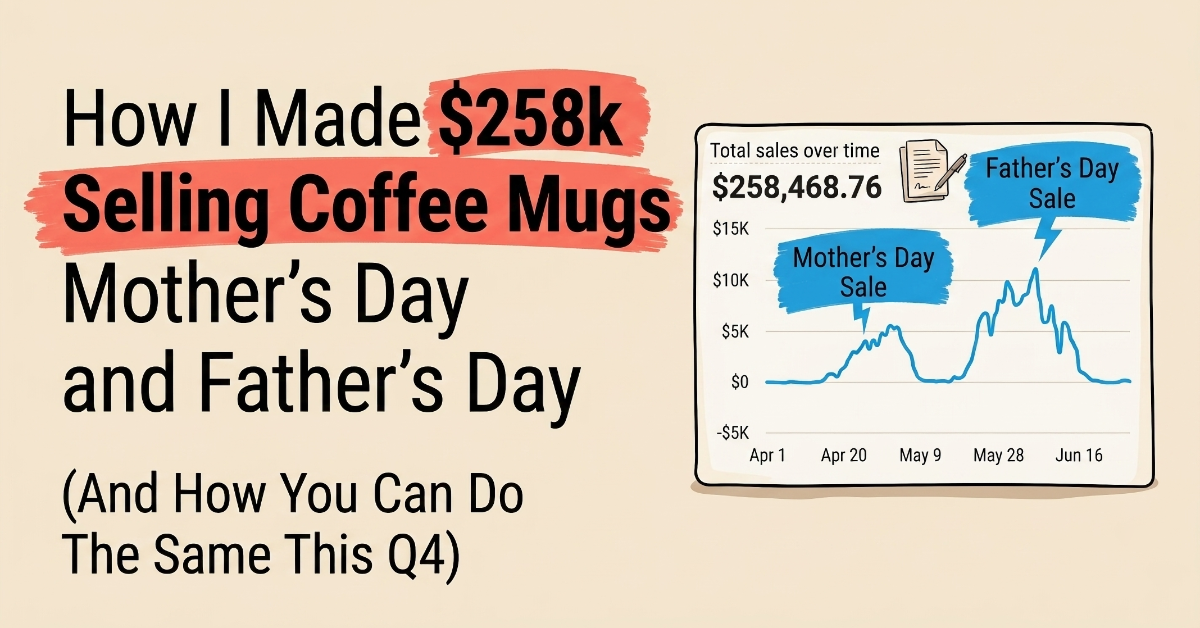
I want to show you how I made $258k selling coffee mugs on the last Mother’s Day and Father’s Day.
Not theory. The actual process.
And by the end of this article, you’ll have a plan you can follow for this coming Q4.
It’s one of the easiest ways I know to make money online. I’m proof it works.
Let’s get into it.
The View From The Top
Before I show you the details, let’s step back and look at the whole thing first.
First, I sell coffee mugs.
Yeah. Plain white coffee mugs. The kind you drink your morning coffee from.
But here’s the thing. I don’t make them.
I pay a supplier to print my design on a mug, pack it, and ship it to my customer for me.
I’ve sold thousands of mugs. I have never touched a single one.
This is called print-on-demand. Lots of suppliers do this now.
You don’t make anything. You just sell.
I use CustomCat as my supplier. They’re cheap and they ship fast.
A mug costs me around $10 to make and ship.
I sell it for $24.90 to $29.90 with free shipping.
So I make around $15 to $20 per mug before ads and marketplace fees.
One note on designs: don’t use trademarked words, brand names, or phrases someone owns. It’s not worth losing your account over.
So where do I sell them?
Two places. Amazon and my own Shopify store.
Amazon is where I test. I throw up tons of mugs and see which designs people actually buy. I run Amazon Ads there too.
Shopify is where I take the winners and scale them to the moon with Facebook Ads.
One thing to be clear about. I sell on Amazon using a normal Amazon Seller account. Not Amazon Merch. Those are two different things.
Here’s the whole system in one line:
Coffee Mug → Amazon + Amazon Ads (testing) → Shopify + Facebook Ads (scaling)
Simple, right?
Now let me walk you through it step by step.
Let’s Throw Spaghetti At The Wall And See What Sticks
Amazon is the biggest marketplace in the US. Tons of people shop there every single day.
To make sales, you need products there. And people need to find them.
If you only have 1 or 2 products, you’re like plankton in the ocean.
Nobody will ever find you.
So I have tons of mugs on Amazon. And they cover many different niches:
- Mechanical Engineer Mugs
- Software Developer Mugs
- Nurse Practitioner Mugs
- Real Estate Agent Mugs
And on and on.
I’m in 300 to 400 niches. Right now I have around 400,000 active products on Amazon. (If you’re wondering where to start, here’s how many products you should upload.)
I’ve been doing this since 2014. The number keeps growing every year.
How I got here
When I started, I made and uploaded every mug myself.
I did it for a few days and got bored out of my mind. The work is repetitive.
So I hired two virtual assistants. One made the designs. The other created and uploaded the mugs to Amazon.
I paid them around $700 to $800 a month. (Can’t remember the exact number.)
Then I built my own tool. I call it PODtomatic.
PODtomatic creates and uploads products to Amazon on autopilot.
The designs are text based. The system has over 200 niches and thousands of quotes built in. It uses those to make the designs.
It does the same work my two VAs did. Except it’s 100% automated.
I just connect my Amazon account and let it run.
When an order comes in, PODtomatic pulls it from Amazon and sends it to CustomCat. CustomCat makes the mug and ships it to my customer. Then PODtomatic grabs the tracking number and updates the Amazon order.
I don’t touch anything.
PODtomatic uploads up to 200 products a day for me. That’s how I got to 400,000 products.
Then I wait
That’s it. I wait for someone to buy.
Because I’m in so many small niches, I get steady traffic from all of them.
When a mug sells, I look at which niche it came from. Then I build an Amazon Ads campaign for every product in that niche.
Here’s a real example.
Say this mug sells:
“Mechanical Engineer. Because Freaking Genius Is Not An Official Job Title.”
I create an Amazon Ads campaign. I add every product with “Mechanical Engineer” in the title. Then I target the keyword “Mechanical Engineer” on broad, phrase, and exact.
Bid: $0.50 or less. Daily budget: $15.
Then I let it run.
Quick note so you don’t panic. I don’t run campaigns for all 300 niches. Only the ones that already made a sale on their own. And Amazon almost never spends the full daily budget anyway.
Once the campaign is running, keep cleaning it up. Kill any product that spends $5 to $10 without a sale.
Adjust that number based on your mug price. You want at least $5 profit, or breakeven at worst.
I repeat this for every niche that makes a sale.
This is the spaghetti method
Throw tons of mugs at Amazon. See what sticks.
Here’s the part most people get wrong.
You won’t make much money at this stage. That’s not the point.
The point is to find your winners. The mugs you’ll scale later with Facebook Ads.
Because the product is everything.
I’d say this business is 90% product and 10% ads.
If you have a real winner, it sells even when your ad setup is dumb and everything is on default.
I’ll show you what I mean.
Is This Really A Winner? (Testing Phase)
After my Amazon Ads run for a bit, I look for products selling consistently.
If a mug makes 5 to 10 sales on small ad spend, I move it to my Shopify store.
Last Mother’s Day and Father’s Day, I found 5 or 6 mugs that stood out on Amazon.
So I put them on Shopify and started testing them with Facebook Ads.
But here’s the honest part.
Selling well on Amazon does not mean it will sell well on Facebook.
Out of those 5 to 6 mugs, only 3 worked on Facebook. Two for Mother’s Day. One for Father’s Day.
That’s why you test first.
You’ll need a real Shopify store for this, not just a single product page. Facebook won’t approve you without one, and buyers won’t trust a page with nothing behind it. Keep it simple. It doesn’t need to be pretty.
My test setup
One campaign per mug. $15 a day each. (More on what to budget for testing.)
That’s it:
- ABO campaign with the Sales objective
- 3 ad sets, one interest each, all placements, $5/day each
- 1 ad. A photo of the mug on a white background.
The copy is nothing fancy:
“Get this Funny Mug for Your Mom This Mother’s Day. Get yours: LINK”
I use the mug name as the headline.
Run it for 2 to 3 days. Then look.
The only two numbers I care about
CPLC (Cost Per Link Click) and CPP (Cost Per Purchase).
CPLC tells me if people are interested. CPP tells me if they’ll actually buy.
Here’s how I read them:
If CPLC is high (over $2) → fix the ad and try once more. Still high? Drop the product. Expensive clicks make profit almost impossible.
If CPP is too high → you can’t even break even. The lower the better.
If CPLC is low but CPP is high → the problem is your product page. Look at your price, your shipping, your layout. Make sure the offer is clear.
You’re selling a coffee mug. The page should not be complicated.
Let people check out fast.
Everything else is noise. Low CPLC. Low CPP. That’s it.
Calm Down. It Might Be A Fluke. (Soft Scaling)
So you ran it for a day or two. CPLC is low. CPP is low.
Do not raise the budget yet.
It might be a fluke.
I’ve had a love-hate relationship with Facebook Ads for years. Some days it hands me great numbers. The next day it takes them away.
So wait. Watch it for another 3 to 4 days.
If the numbers hold, now you can soft scale.
There are a lot of ways to do this. Here’s what I usually do:
- Make a new ad set with a new audience, using the same ad
- Or slowly raise the daily budget
Then watch again. Check CPLC and CPP on the new ad sets and the old ones.
If they stay low for another 3 to 4 days, you’ve got a winner.
Now it’s time to go big.
Scale This Unicorn To The Moon (Aggressive Scaling)
Your CPP is steady, or maybe creeping up a little. Good. Time to scale hard.
But first, one thing.
Build your retargeting campaign first
If you don’t know what retargeting is, it’s simple.
It’s an ad that follows people who saw your first ad, didn’t buy, and brings them back.
When you send massive traffic to a product, a lot of people look and leave. Retargeting is how you catch them.
My retargeting ads usually say something like:
“Hey! Did you forget a gift for your mom? We’re giving 10% off this coffee mug. Grab it TODAY before the discount is gone!”
To set this up, I build three custom audiences:
- Visitors → people who viewed the product page
- Buyers (pixel) → built from the Facebook Purchase event, narrowed by the product URL
- Buyers (email) → built from my customer email list
Why two buyer audiences?
Because I don’t fully trust the Facebook pixel to fire correctly every time. So I build a backup from my customer emails.
Then in my ad set: include audience 1. Exclude audiences 2 and 3.
Now my ad only shows to people who looked but didn’t buy.
Now scale
During testing and soft scaling, I used ABO. Then a mix of ABO and CBO.
For aggressive scaling, I go CBO only.
Three things matter here:
- Campaign Budget Optimization (CBO)
- Winning Facebook Interests (the ones you found in testing)
- A BIG daily budget ($500 to $5,000 per day)
Before you push the budget up, check your cash flow.
If you use Stripe or Shopify Payments, they hold your money for a while before you can withdraw it. So you’re paying Facebook today for money that lands in your bank next week.
Don’t set a budget your bank account can’t survive.
In this phase I only use the interests that already proved themselves.
Then I watch CPLC and CPP again. Keep them low. Keep the profit.
One thing to expect. Your CPP will not be as low as it was during soft scaling. The budget is much higher now. That’s normal.
But we care about net profit, right?
And net profit per day at this stage is way, way higher than soft scaling.
Reach New People With Lookalike Audiences
A Lookalike Audience is the second best audience for making lots of sales.
Hmm. Only second best?
Yep. I’ll show you the best one in a minute.
First, lookalikes.
Once you’ve made some sales, your Facebook pixel has data. It knows who visited your site, who added to cart, who bought.
Use that data.
Here are the three lookalikes I build:
- People who clicked Add to Cart
- People who Purchased
- People who Engaged with your Page posts*
*This last one only works well if your Page is niche focused. If your Page attracts all kinds of people, it won’t perform.
Make three ad sets, one for each.
If the 1% lookalike does well, I test wider. 1-2%, then 2-3%, and so on.
You can scale a long way with this.
The Best Audience: ‘No Target’
Okay. Here’s the best audience I found for Mother’s Day and Father’s Day.
No Target.
It’s not based on interests at all. I create the ad set and leave the interest field completely blank.
Everything else stays on default.
Then I set a daily budget of $1,000 to $5,000 a day.
Why so high?
Two reasons. The ads are easy to manage. And I avoid audience overlap.
If you have a bunch of ad sets chasing the same people, they compete with each other. Your costs go up.
After running a lot of these for Mother’s Day and Father’s Day, No Target beat my interest campaigns. Not by a little. By a lot.
You may have seen this picture
It’s been posted in a hundred Facebook marketing groups.
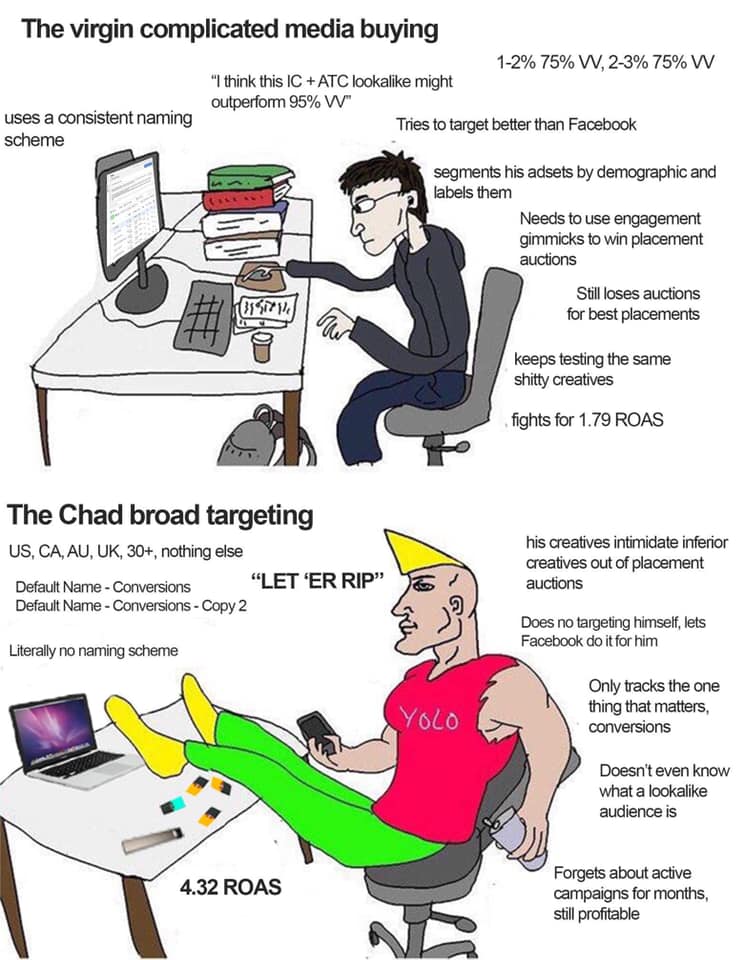
The guy on top is the “virgin of complicated media buying.” He has layers of strategy. Complicated ad set structures. Even a complicated naming system.
The guy on the bottom is “the Chad broad targeting.” He leaves almost everything on default.
I’ll be honest with you. My strategy is Chad’s.
I don’t make things complicated. 🙂
Like I told you earlier. The product is what matters. If the product is a winner, scaling is easy.
So Which Audience Should You Use?
All of them.
Here’s my order:
- Interests first (this is how you find your winning angles)
- Lookalikes next (built from the data your first sales gave you)
- No Target last (this is where the big budget goes)
They all work. Test them in that order and let the numbers pick the winner.
Your Q4 Plan
Alright. Now you know exactly how I made $258k on Mother’s Day and Father’s Day.
Let’s build your plan for Q4.
Let me say this again, because it matters.
Q4 is where you can make 80% of your yearly sales.
I’ve written a longer Q4 preparation checklist if you want the full run-through.
It’s bigger than Mother’s Day and Father’s Day combined. Way bigger.
Moms, dads, sons, daughters, grandma, grandpa, aunts, uncles, friends, coworkers. Everyone is buying gifts for someone they love.
You can work hard for one quarter and outsell the rest of your year.
But only if you’re ready.
The timeline
- August → Upload. Start now and don’t stop.
- September → Turn on Amazon Ads
- October → Move winners to Shopify and test with Facebook Ads
- November → Scale
- December → Scale, scale, scale until the shipping cutoff*
*The shipping cutoff is usually mid December. Check with your supplier for the exact last day they can ship and still arrive before Christmas. When that day passes, turn your ads off. Don’t leave campaigns running and take money for gifts that won’t arrive in time. That’s how you end up refunding your whole Q4.
A few things people always ask
“Do I need special Christmas designs?”
No. Your normal niche quotes work fine. A funny Mechanical Engineer mug is a great gift in December. Don’t overthink it.
“Are Facebook costs way higher in Q4?”
They go up a little, but it’s not much different from Mother’s Day. Same rules. Same numbers. Watch CPLC and CPP like always.
“What if I’m starting from zero?”
You won’t have 400,000 products by November. That’s fine.
If your Amazon account is brand new, start at 10 to 20 products a day and build up slowly. Don’t blast it on day one.
A few thousand products in your account by November is enough to find winners. Just keep uploading and keep testing with Amazon Ads.
The one thing that matters most
You need ONE winning product.
That’s it. On Facebook Ads, one winner is enough to do $100k in sales.
Last Mother’s Day I had 2 winners. Father’s Day, just 1.
But to find that one, you have to upload a lot of products across a lot of niches. There’s no shortcut around the volume.
And in Q4, if you find winners in different niches, scaling gets easier. The audiences don’t overlap, so you have a much bigger pool of people to sell to.
So here’s your job right now:
Upload tons of mugs, in as many niches as you can, to Amazon. (My year-round mug strategy walks through the non-seasonal version of this.)
Run Amazon Ads on the niches that sell.
Move the clear winners to Shopify and test them with Facebook Ads fast.
Then scale.
Recap
Here’s the whole thing in five lines:
- Upload tons of products across many niches to Amazon
- Run Amazon Ads on the niches that make sales
- Pick the products that sell consistently and put them on Shopify
- Run Facebook Ads. Test first.
- Soft scale, then aggressive scale
Simple, right?
The hard part is finding the winner. But once you have thousands of products sitting on Amazon, winners show up on their own. Regularly.
You just have to be uploading.
Now it’s time to take action.
You’re one product away.
👉 Go to PODtomatic.com and let it start uploading products to your Amazon account. Find your Q4 winner.
Enjoy the process.
Bank K.
